Captivity
Hayden's TimbreCaptivity in the novel is not merely physical confinement; it is a system of coercive control directed at Timbre Simons and enforced through isolation, humiliation, threatened violence, economic pressure, and forced migration. Krissy Thompson and Ella use Timbre’s attachment to Hayden Devillier and Crew Devillier as the central instrument of control, while Timbre’s eventual escape preserves her agency within circumstances designed to remove it.
Definition and Conditions
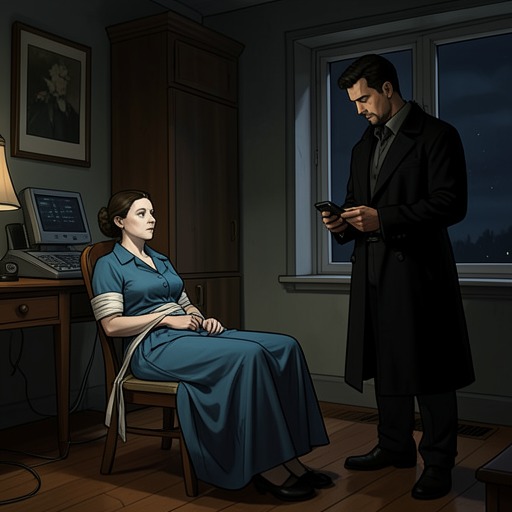
Captivity begins with a stark reversal of safety. Timbre is found unconscious after struggling to reach the kitchen, still wet and wearing the terry robe Hayden bought her. A voice insults her and orders her awake before someone roughly pulls her by the arm. The scene makes her vulnerability material: she is disoriented, unable to control her body, and confronted by captors before she can understand where she is or summon help.
The captors then convert physical restraint into a broader regime of domination. Timbre realizes that her hands are tied behind her back, and Ella displays a knife while threatening to cut her face. The threat is not only bodily injury but the destruction of her appearance and, by implication, her future ability to be wanted or recognized. Krissy stops the proposed mutilation, but only because the captors need Timbre alive and functional for their larger plan. Violence therefore remains present even when it is temporarily withheld.
Threats, Isolation, and Forced Movement
Krissy’s demand is that Timbre disappear completely, leave the Austin area, and go anywhere outside a thousand-mile radius of Austin. The order is backed by threats against Crew Devillier, whom Krissy calls the child responsible for her problems and her own son. She promises lasting harm to him if Timbre returns or even makes contact. Timbre’s apparent agreement is consequently not consent to departure; it is a calculation made under duress, directed toward protecting an innocent child and Hayden.
The control also includes economic coercion. When Timbre asks how she can survive with nothing, Krissy dismisses the problem and suggests that she support herself through sexual exploitation. The insult reduces Timbre’s previous struggle and new life to a degrading stereotype, while the demand that she obtain money immediately forces her to think about reaching a bank or ATM. The captors thus attack both her physical security and her sense of social and economic possibility.
The forced relocation becomes concrete when Timbre boards a bus while Krissy and Ella watch. They intend to follow her by car until she is outside the city limits, making the bus a vehicle of expulsion rather than ordinary transportation. Timbre describes the experience as a nightmare, yet her decision to board is an act of survival: she accepts displacement because refusing may expose Crew and Hayden to violence.
A Pattern of Control and Protection
The captivity storyline echoes earlier warnings about danger on public transportation. Hayden had already condemned Timbre for taking a bus alone at night after police officers intervened and the other passengers left. He imagined the possibility of a gun or knife forcing her from the bus without the driver knowing, then apologized after recognizing that his anger came from fear. Later, when Timbre takes a bus from Mountain Grove after walking along a busy road, Hayden again focuses on the danger of traffic, strangers, and abduction.
These earlier scenes create an important contrast with the actual kidnapping. Hayden’s protective response is intrusive and angry, but it ends in apology and physical reassurance; Krissy and Ella’s control is deliberate, punitive, and backed by weapons and threats to a child. The repetition of buses, nighttime vulnerability, and fear transforms what initially appears to be overprotective concern into ominous preparation for the later captivity. At the same time, the contrast prevents all forms of restriction from becoming morally identical: Hayden’s fear seeks to preserve Timbre’s safety, whereas the captors seek to eliminate her freedom.
The Powell household also contains a smaller example of authority policing behavior when a family member says that Tucker Powell has allowed his mouth to get him into trouble and another speaker refuses to let locker-room language enter the room. That domestic discipline is sharply different from captivity because it operates within recognizable family boundaries and does not involve isolation, bodily restraint, or threats against a vulnerable person. The novel’s larger conflict depends on this distinction between imperfect protection and coercive domination.
Discovery, Rescue, and Legal Consequences
The captivity ends through Timbre’s own attempt to reach outside authority. When the bus stops, she calls 911 and reports that she has been kidnapped. Police take her to the station in Amarillo for questioning, which briefly places her in another institutional setting but confirms that she is no longer under Krissy and Ella’s direct control. The police detective tells Hayden Devillier and Ryan Powell that Timbre is safe and will need to make a statement.
The discovery of her survival changes the meaning of the preceding threats. Krissy refuses to reveal what happened to Timbre, leaving Hayden afraid that she may have killed her. The uncertainty extends the captivity’s power beyond the moment of physical confinement: even after Krissy is arrested, Timbre’s whereabouts remain unknown to the people who love her. Once the detective confirms that she called from the bus, however, the story turns from feared murder to recoverable testimony.
The legal aftermath treats Timbre as a necessary witness rather than as a silent object rescued by others. The detective explains that her testimony will help put both women away, and Hayden accepts that she must tell the whole story. Krissy is taken away in a police car, while Ella is transported to an ambulance after suffering a gunshot wound to the shoulder during the armed confrontation at the Devillier household. Their removal does not erase the damage, but it ends their immediate power to dictate Timbre’s movements.
Return and Significance
Ryan arranges for the family plane to retrieve Timbre from Amarillo. When the plane lands, Hayden sees her beside a police car and rushes to her. He asks whether she was hurt; Timbre answers that she is fine, though somewhat roughed up. The reunion with Crew Devillier completes the emotional reversal: he jumps from the plane’s steps, Timbre embraces him, and Hayden gathers both of them into his arms.
The final movement from a forced bus to a family plane, and from threatened exile to the declaration of “Our home,” gives captivity a structural counterimage. The captors tried to sever Timbre from Austin, Hayden, and Crew by making departure the price of their safety. Her return instead confirms that the household cannot be redefined by the people who attacked it. Captivity exposes the fragility of Timbre’s chosen family, but the rescue and reunion show that its bonds remain the force organizing the story after violence has tried to break them.